Let’s be honest: the drone world loves its acronyms. UAV, UAS, drone, RPAS, UCAV, FPV–it’s an alphabet soup. And most people use them like they’re the same thing.

They’re not.

And here’s why that matters to you: if you’re shopping for an industrial drone – say, for surveying, inspection, or public safety – picking the wrong term can mean buying the wrong product. You might end up with just a flying machine… and no ground control, no software, no way to actually use it legally.

That's a costly mistake.

So we wrote this guide to cut through the jargon. No fluff. Just clear answers on:

  • What actually separates a UAV from a UAS (and a drone from both)

  • How the military looks at them (groups 1–5 explained simply)

  • What things really cost – not just the aircraft

  • The four main types of UAVs, and which one fits your mission

  • Pros, cons, regulations, and a straight-up buying recommendation

By the end, you’ll know exactly what to ask for and what to avoid.

Core Comparison – UAV vs. UAS vs. Drone

Core Comparison – UAV vs. UAS vs. Drone

Let’s start with the simplest question: what’s the actual difference between a UAV, a UAS, and a drone?

The short answer is scope.

Think of it like a car:

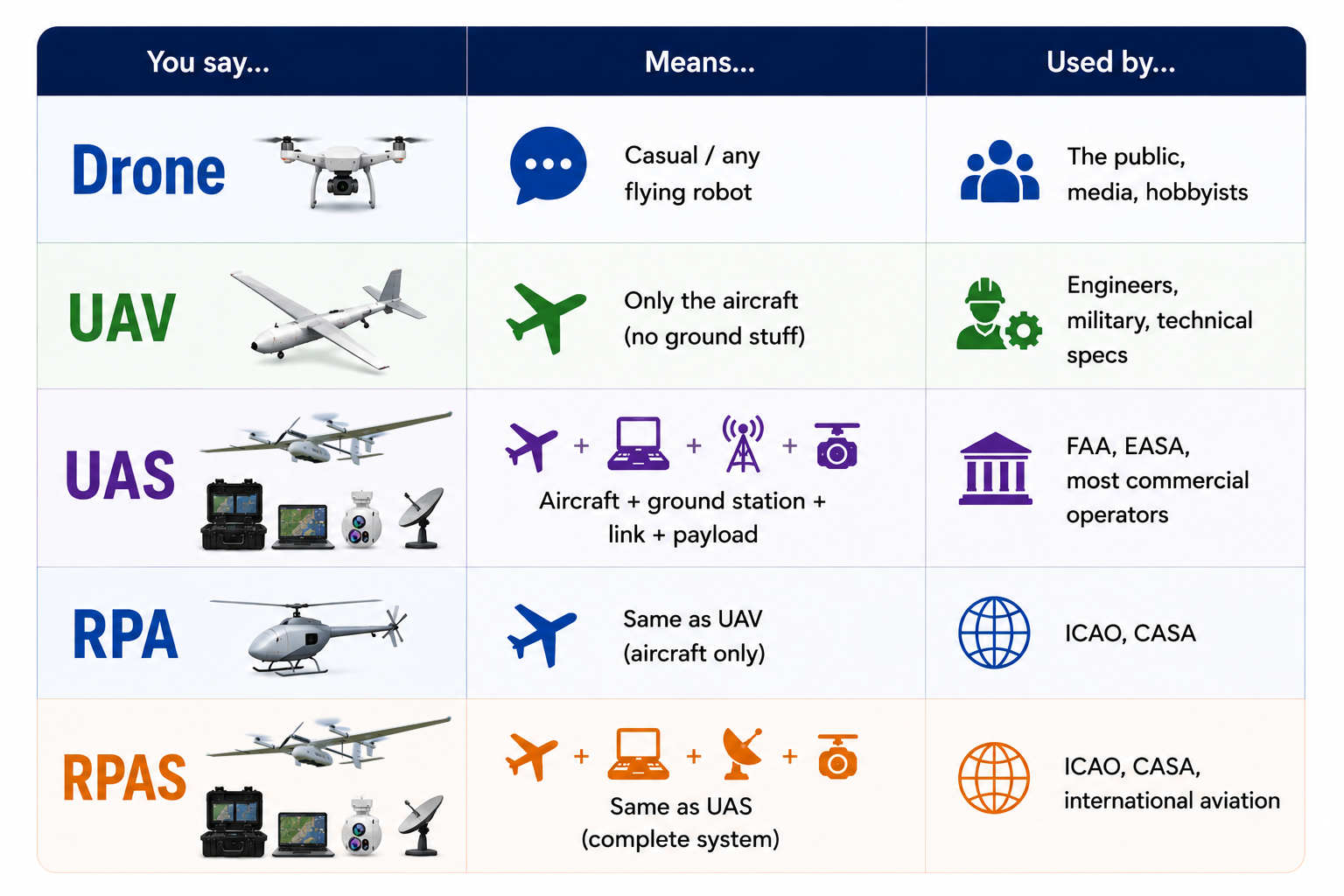
  • "Drone" is the casual word, like saying "ride". It can mean anything from a toy helicopter to a military Predator.
  • "UAV" (Unmanned Aerial Vehicle) is the car itself—the chassis, engine, and wheels. No driver, no fuel, no radio.
  • "UAS" (Unmanned Aircraft System) is the whole package—the car, the keys, the GPS, the mechanic, and the driver’s manual.

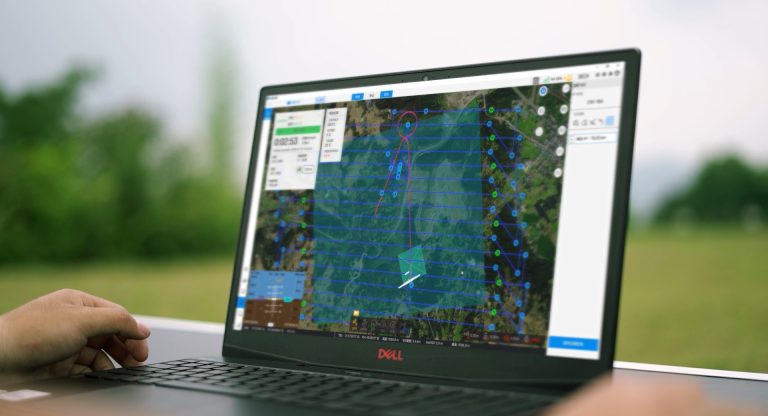
In the drone world, that “whole package” includes the ground control station, the data link, the payload (camera, LiDAR, etc.), and the software that makes everything work together.

Here’s how they stack up side by side:
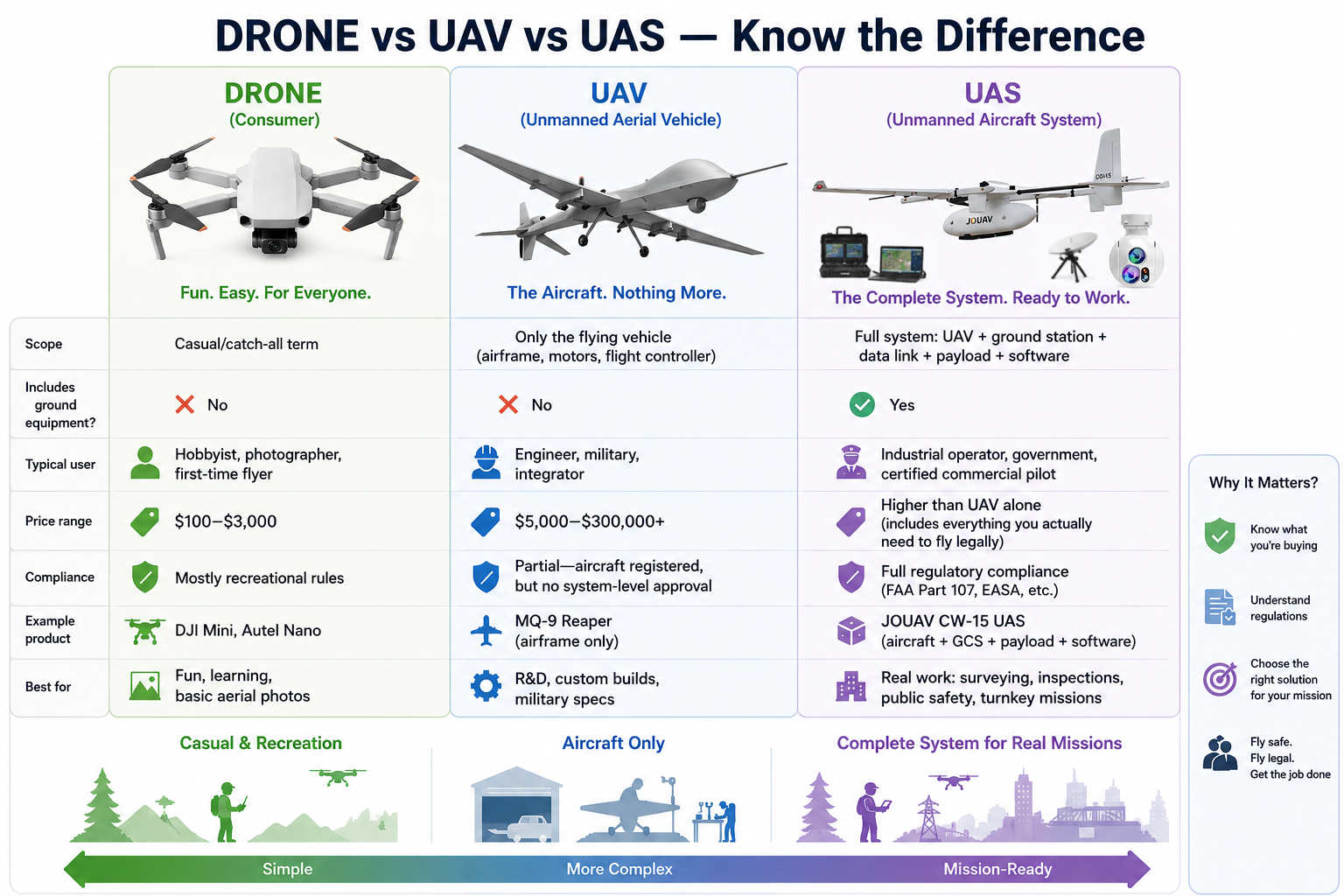
Drone vs. UAV vs. UAS

Why does this difference matter for you?

Remember this rule: "Drone" is a vague idea. "UAV" is half a system. UAS is the whole answer.

If you go online and search for a "drone" to map a power line or inspect a bridge, you’ll get thousands of results—most of them toys.

If you search for a "UAV", you’ll find airframes. But you’ll still need to buy a ground controller, a separate payload, and figure out the software yourself. That’s doable if you’re an integrator. It’s a headache if you’re a surveyor who just wants to get the job done.

If you search for a UAS – that’s when you start seeing complete, ready-to-fly solutions. The kind where you open one case, unfold the ground station, and launch within 15 minutes.

Now let’s dive into why the military and regulators care so much about this distinction – and why you should too.

Military Perspective – UAV vs. UAS vs. Drone vs. UCAV

Military Perspective – UAV vs. UAS vs. Drone vs. UCAV

The military doesn’t use these terms loosely. When lives and budgets are on the line, every word has a specific meaning.

Let’s walk through how the U.S. Department of Defense and other military branches draw the lines between UAV, UAS, drone, and UCAV.

Military Definitions

  • Military UAV – The aircraft itself. Think MQ-9 Reaper or RQ-4 Global Hawk. No ground station, no weapons (necessarily), just the flying machine.
  • Military UAS – The entire operational system. That includes the UAV, the satellite or line-of-sight data link, the ground control station, the intelligence processing equipment, and the personnel who run it. A UAS is what actually goes to war.
  • Drone (military slang)—Usually refers to small, lower-cost, often expendable unmanned aircraft. Sometimes used for target practice or by irregular forces. The term carries a lighter, less formal tone—you won’t hear a general say “launch the drone” in a formal briefing.
  • UCAV (Unmanned Combat Aerial Vehicle) – A UAV with weapons. Bombs, missiles, or both. Not all military UAVs are UCAVs—many are pure reconnaissance (ISR). But all UCAVs are UAVs. Examples: MQ-9 Reaper (when armed), X-47B.

US DoD UAS Groups (1–5)

The U.S. military classifies unmanned systems into five groups based on weight, altitude, and speed. This is useful because it shows how different “UAS” can be – from a hand-launched Raven to a Global Hawk that flies higher than most jets.
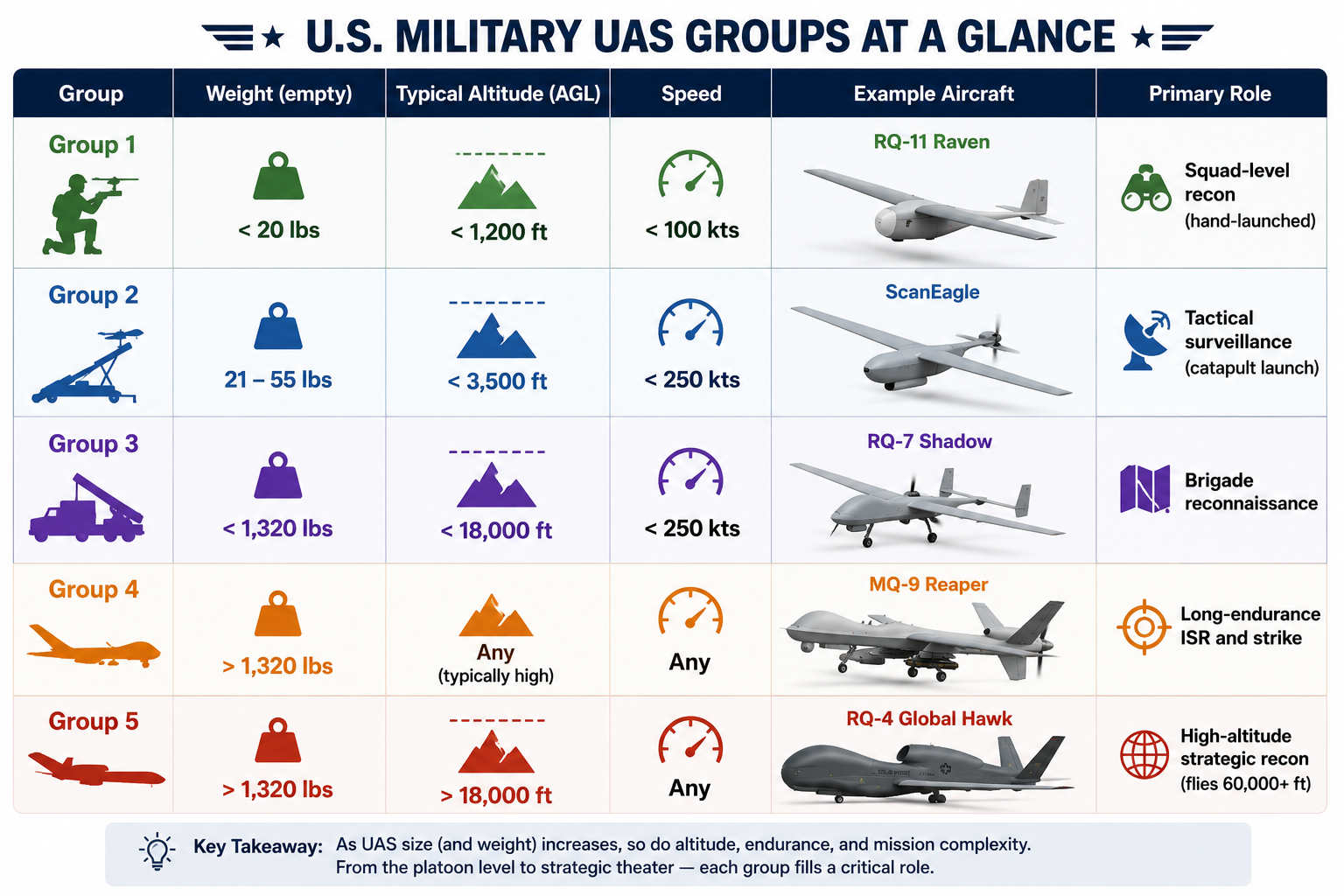
US. military UAS group at a glance

Why this matters to you (even if you’re not military)

If you’re buying an industrial UAS, you don’t need Group 5 performance. But understanding these groups helps you ask better questions:

  • How heavy is it? (Regulations often use weight thresholds)
  • How high does it need to fly? (Power line inspection vs. large-area mapping)
  • How long does it stay up? (30 minutes vs. 4 hours changes everything.)

The military spent billions figuring out these tradeoffs. You can learn from their framework without paying their prices.

Next, let’s talk about what this all costs—because the difference between a UAV and a UAS shows up clearly in your invoice.

Cost Analysis – UAV vs. UAS Price

Cost Analysis – UAV vs. UAS Price (What You Really Pay)

Let’s talk money. Because this is where most buyers get tripped up.

You see a “UAV” listed for $15,000. Looks great. Then you start adding the things you actually need to fly a real mission—ground control, batteries, payload, software license, and training. Suddenly, you’re at $45,000.

That’s not a bait-and-switch. That’s the difference between buying a vehicle (UAV) and buying a working system (UAS).

Here’s what you actually pay for each.
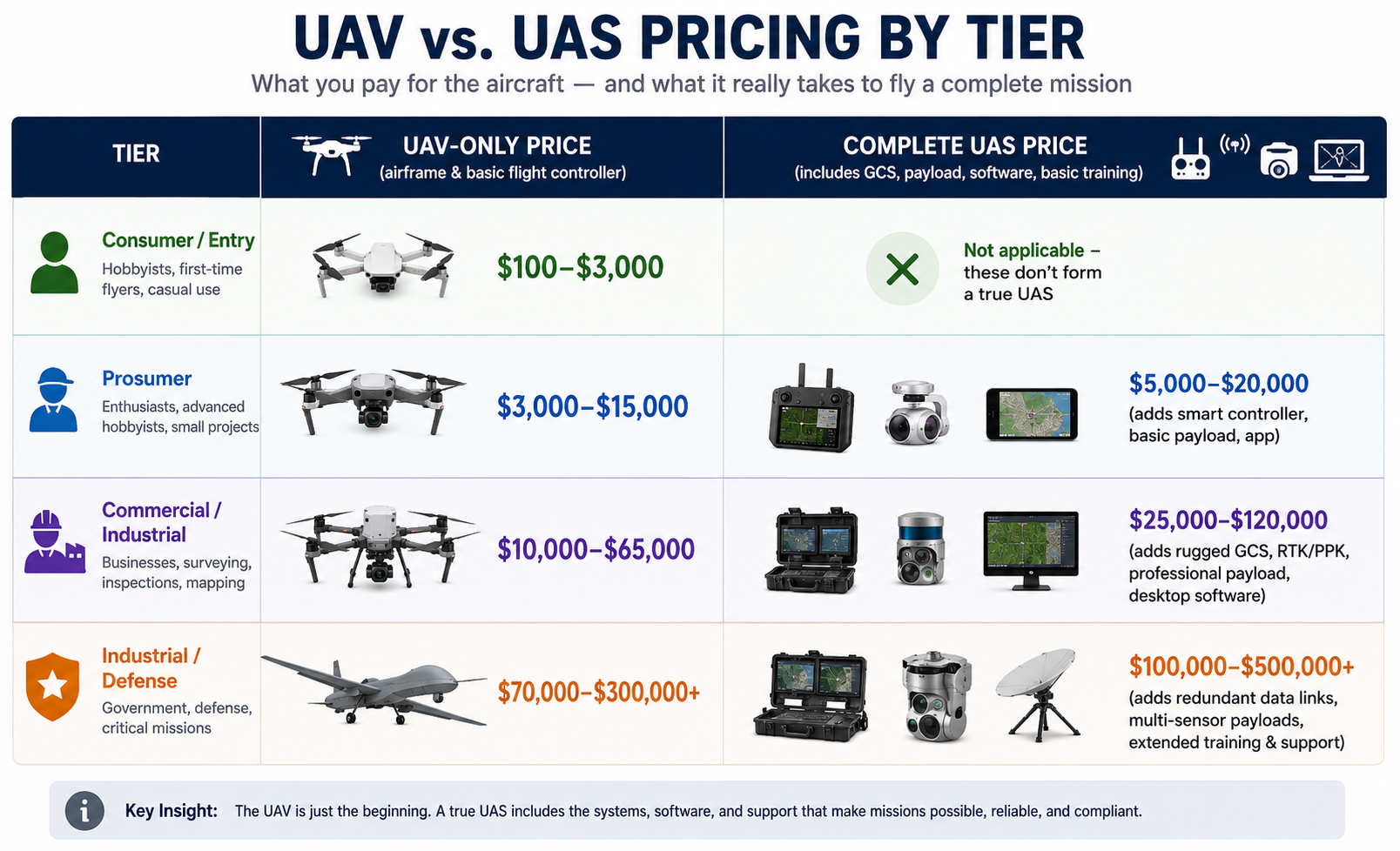
UAV vs. UAS price

Real example: A high-end fixed-wing mapping UAV might cost $35,000. But the full UAS – with a ground control tablet, PPK base station, 61MP camera, flight planning software, and a week of training – easily hits easily hits $55,000–70,000.

The Cost Pitfalls Nobody Talks About

Pitfall #1: The “just the aircraft” trap

You buy a UAV. Then you realize you need a ground controller – that’s $3,000–8,000. A proper payload (not a GoPro) – another $5,000–$25,000. Software licenses – $1,500/year.Training–$1,500/year.Training–$2,000–$5,000. Suddenly you’ve spent double.

Pitfall #2: Compliance costs sneak in

A bare UAV isn’t Part 107 compliant out of the box. You’ll need Remote ID, a registered ground control system, and often a custom safety case. That’s time and money.

Pitfall #3: Support is not optional

When your UAV crashes or glitches, who do you call? With a UAV-only purchase, you’re often on your own. A UAS comes with manufacturer support – which is worth every penny on the second day of a field campaign.

What Industrial Buyers Should Budget (Real Benchmarks)

Based on real projects—not marketing brochures:

  • Fixed-wing mapping UAS (full system): $25,000–$60,000

Includes: fixed-wing UAV, PPK/RTK, high-res mapping payload, ground control, basic software

  • VTOL hybrid UAS (full system): $40,000–$120,000

Includes: VTOL airframe, dual payload capability (EO + LiDAR or thermal), rugged GCS, advanced mission planning

  • LiDAR UAS (full system): $60,000–$200,000+

Includes: UAV, LiDAR sensor (e.g., Riegl or Livox), IMU, post-processing software, calibration tools

A Quick Rule of Thumb

If a quote says "UAV", expect to add 40–80% to get a working UAS.

If a quote says "UAS", you’re looking at the real price to do real work.

Next, let’s look at the four main types of UAVs—because not all flying machines are built for the same job.

The 4 Types of UAV (And Which One Fits Your Mission)

The 4 Types of UAV (And Which One Fits Your Mission)

Not all UAVs are built the same. The right one for a real estate photo shoot is useless for a 50‑km pipeline patrol.

The most practical way to sort them is by how they stay in the air. That gives you four basic types.
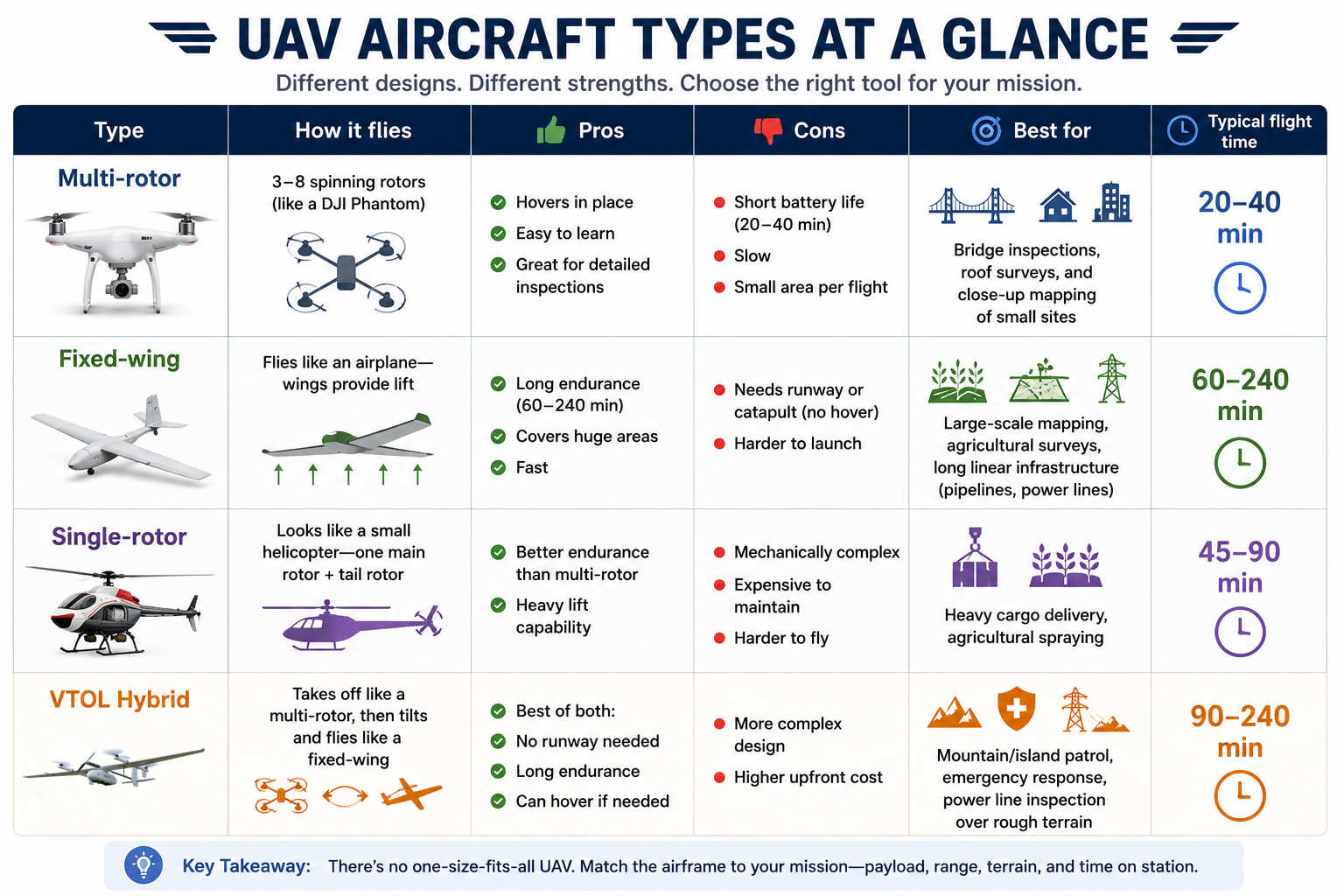
Types of UAVS

Which one do most industrial buyers actually need?

If you’re doing serious work – surveying hundreds of hectares, inspecting transmission lines across valleys, or delivering supplies to a remote site – the choice usually comes down to fixed-wing vs. VTOL hybrid.

  • Fixed-wing drones give you maximum endurance and the lowest cost per square kilometer. But you need a launch catapult or a runway, plus a large open area to land.
  • VTOL hybrid drones give you 80–90% of the endurance, but you can launch from a truck bed, a ship deck, or a small clearing. That convenience is a game‑changer for real‑world operations.

Where JOUAV fits

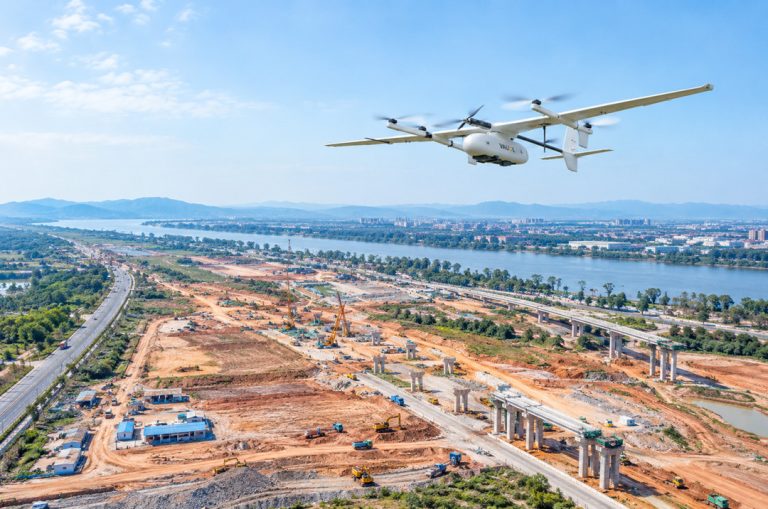
We specialize in VTOL hybrid UAS. Our CW‑15E and CW‑30E take off vertically, transition to fixed‑wing flight, and cruise for 2 to 4 hours. You don’t need a runway. You don’t need a catapult. You just need a few square meters of flat ground.

  • CW‑15E – 180 min endurance, 3 kg max payload capacity. Perfect for medium‑scale mapping and inspection.
  • CW‑30E – 480 min endurance, 8 kg max payload capacity. Carries heavier payloads (LiDAR, SAR) and covers entire counties in one flight.

A quick decision guide
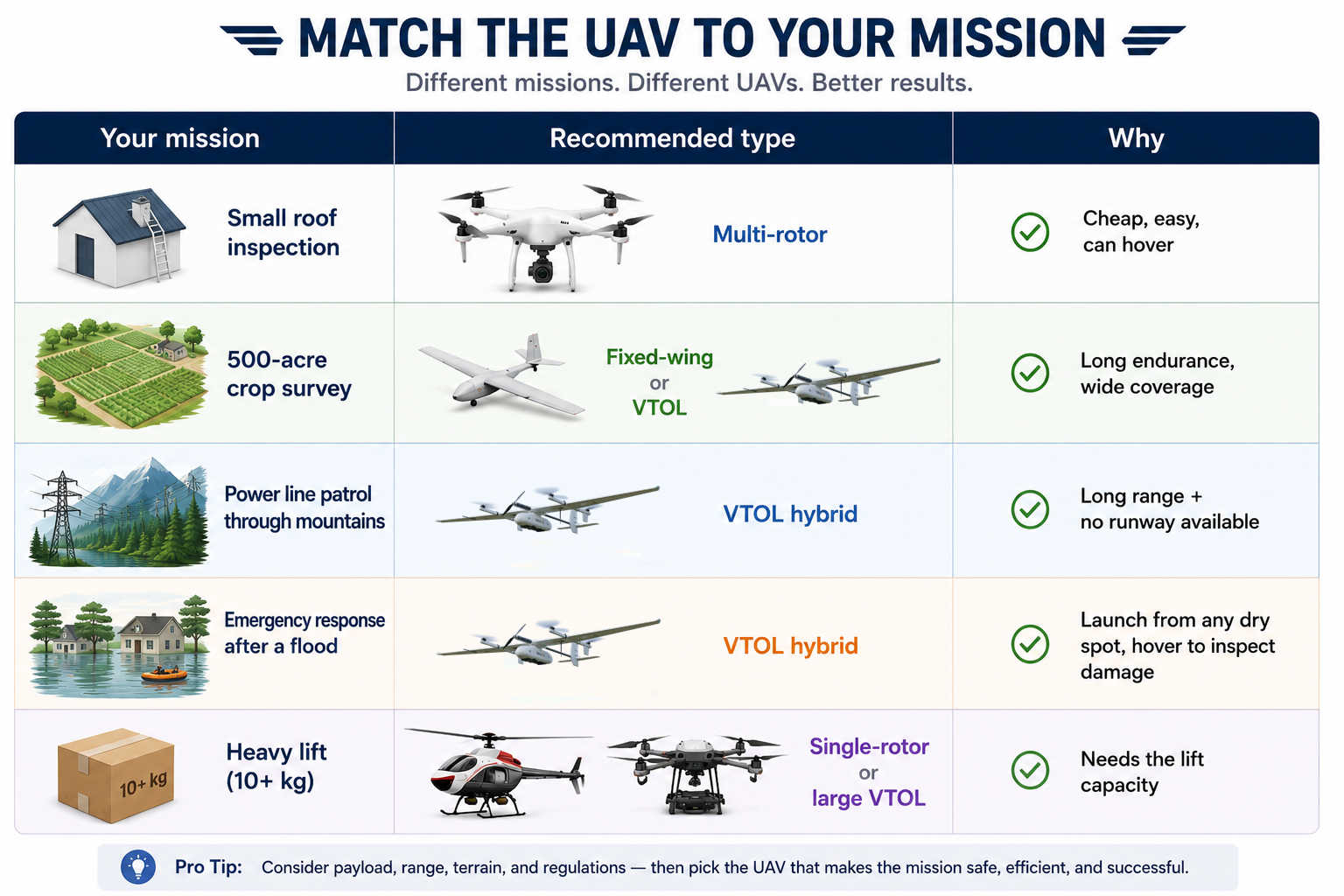
Your missionRecommended typeWhy
Small roof inspectionMulti‑rotorCheap, easy, can hover
500‑acre crop surveyFixed‑wing or VTOLLong endurance, wide coverage
Power line patrol through mountainsVTOL hybridLong range + no runway available
Emergency response after a floodVTOL hybridLaunch from any dry spot, hover to inspect damage
Heavy lift (10+ kg)Single‑rotor or large VTOLNeeds the lift capacity

Bottom line: If you have a runway or a cleared field, a fixed‑wing UAV will save you money. If you need to operate where runways don’t exist (most of the real world), get a VTOL hybrid UAS.

Next, let's weigh the pros and cons of UAV vs. UAS one more time–so you can confidently choose what to buy.

UAV vs. UAS – Pros and Cons at a Glance

UAV vs. UAS – Pros and Cons at a Glance

By now, you know the difference. But let’s be practical: when should you buy just a UAV, and when should you invest in a full UAS?

Here’s the honest trade-off.
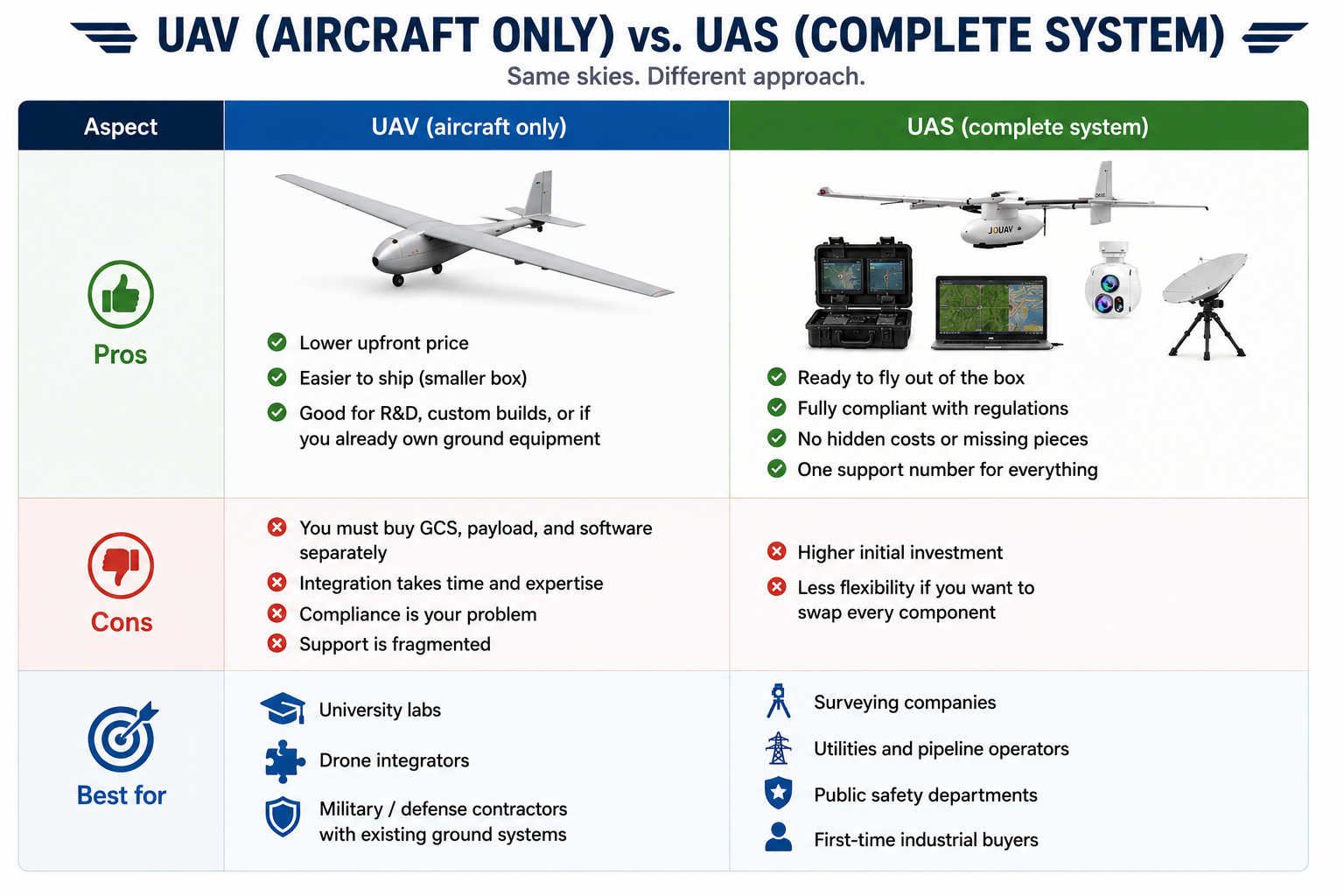
AspectUAV (aircraft only)UAS (complete system)
Pros

– Lower upfront price

– Easier to ship (smaller box)

– Good for R&D, custom builds, or if you already own ground equipment

– Ready to fly out of the box

– Fully compliant with regulations

– No hidden costs or missing pieces

– One support number for everything

Cons

– You must buy GCS, payload, and software separately

– Integration takes time and expertise

– Compliance is your problem

– Support is fragmented

– Higher initial investment

– Less flexibility if you want to swap every component

Best for

– University labs

– Drone integrators

– Military / defense contractors with existing ground systems

– Surveying companies

– Utilities and pipeline operators

– Public safety departments

– First-time industrial buyers

The hidden cost of “just a UAV”

Let me give you a real example.

You buy a fixed‑wing UAV for $18,000. Great. Then:

  • Ground control station (rugged tablet + antenna) – $4,000
  • RTK/PPK module for accuracy – $3,500
  • Mapping camera (not a GoPro) – $8,000
  • Flight planning and processing software – $2,500/year
  • Training for two pilots – $3,000

Total: $39,000 – more than double your original budget.

And you still have to figure out who to call when the autopilot glitches.

When buying a UAS actually saves you money

A complete UAS might list at 38,000. That sounds expensive compared to the 18,000 UAV. But it includes everything above – GCS, RTK, payload, software, training. Plus a single warranty and a support team that knows the whole system.

You pay once. You open one box. You fly.

JOUAV's take

We sell both UAV-only for integrator partners and full UAS for end users. But for 90% of industrial buyers, the UAS is the smarter financial decision. Not because we want to sell more, but because we’ve seen too many customers nickel‑and‑dime themselves into a pile of incompatible parts.

A UAV is a project. A UAS is a tool.

Next, let’s talk about regulations—because the term you use affects whether you can legally fly at all.

Regulations & Compliance – Why the Right Term Matters for Your License

Regulations & Compliance – Why the Right Term Matters for Your License

You might think regulators don’t care whether you call it a UAV or a UAS.

They do.

And if you use the wrong term on your application, in your operations manual, or on your equipment list, you could slow down your approval – or get it rejected entirely.

Let me explain why.

Regulators Don’t Regulate “Drones”

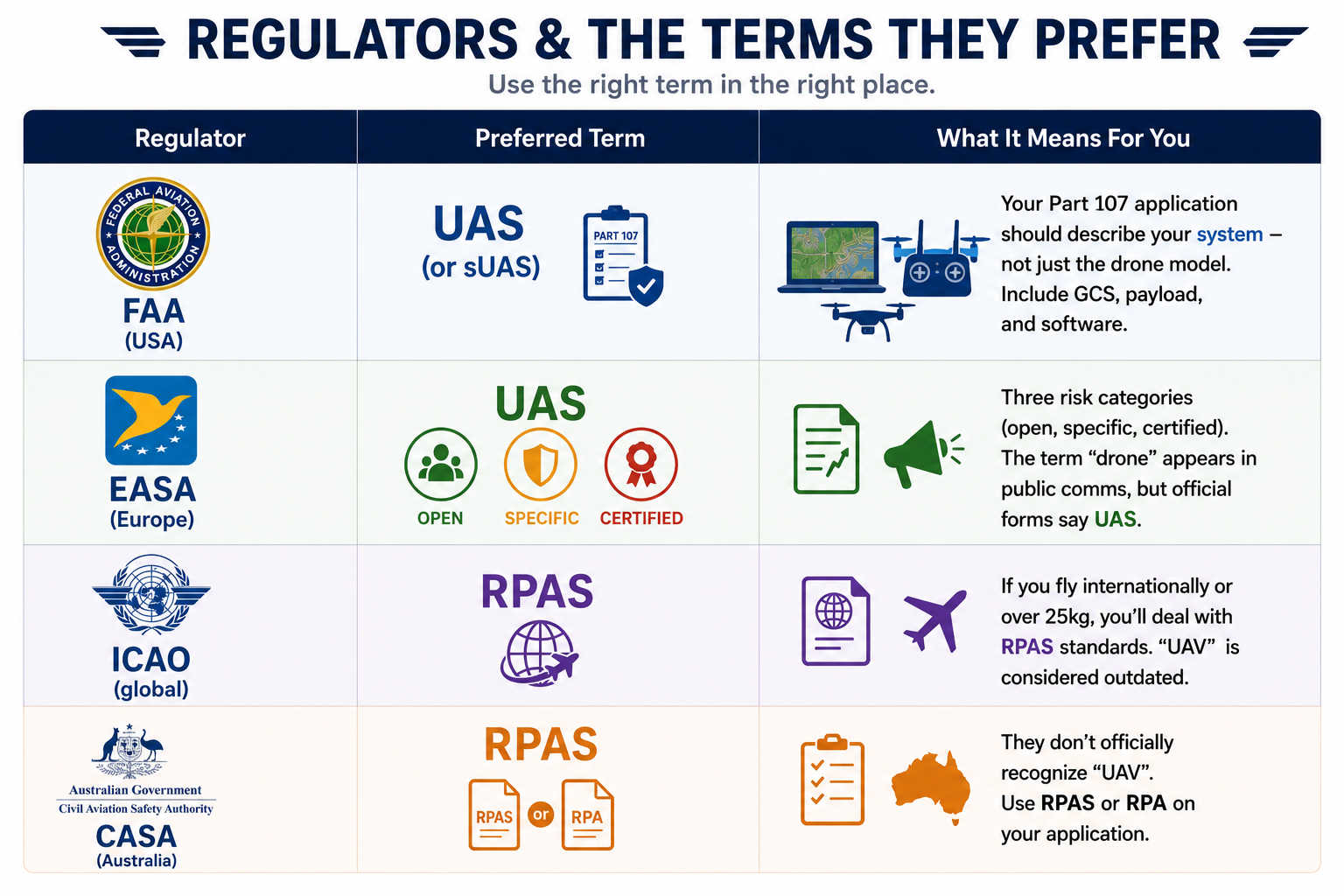
Here’s the thing: the FAA, EASA, and ICAO don’t have a “drone” category. They have rules for Unmanned Aircraft Systems (UAS) or Remotely Piloted Aircraft Systems (RPAS) .

Why? Because they need to certify the whole chain – the aircraft, the ground control, the data link, the pilot, and the procedures. If you only register a “UAV” (just the flying part), you haven’t given them the full picture. And incomplete paperwork means no license.

What Each Major Regulator Actually Calls It

RegulatorPreferred TermWhat It Means For You
FAA (USA)UAS (or sUAS)Your Part 107 application should describe your system – not just the drone model. Include GCS, payload, and software.
EASA (Europe)UASThree risk categories (open, specific, certified). The term “drone” appears in public comms, but official forms say UAS.
ICAO (global)RPASIf you fly internationally or over 25kg, you’ll deal with RPAS standards. “UAV” is considered outdated.
CASA (Australia)RPASThey don’t officially recognize “UAV”. Use RPAS or RPA on your application.

How this trips up industrial buyers?

Scenario 1 – Writing a tender: You ask suppliers to quote for a “UAV”. They give you just the aircraft. You get a great price. Then you realize you have no ground station, no payload integration, no software. The regulator asks for your “UAS safety case” – and you can’t provide it because you don’t have a complete system.

Scenario 2 – Applying for an operating license: You submit paperwork that says “drone model X”. The regulator asks: “Where is your ground control station specification? Where is your data link analysis? Where is your maintenance plan for the entire system?” You have to go back and resubmit. That’s weeks or months lost.

Scenario 3 – Buying used equipment: You find a cheap “UAV” online. It arrives. You then discover the manufacturer no longer supports the ground control software. The regulator won’t accept an unsupported system. You’re stuck with a paperweight.

The Smart Buyer’s Checklist

To avoid compliance headaches, do this:

  • Use “UAS” in all official documents – tenders, license applications, insurance forms.
  • Ask your supplier for a complete system declaration – including GCS, data link specs, and software version.
  • Check regulator guidance for your region – FAA Part 107, EASA’s easy access rules, or CASA’s RPAS framework.
  • Keep a single document that describes your entire UAS – aircraft serial number, GCS model, payload, software version, and maintenance log.

How JOUAV Helps With Compliance

We don’t just ship you a box of parts. Every JOUAV UAS comes with:

  • A complete system technical file (ready for regulator submission)
  • Pre-configured ground control software that meets Part 107 / EASA logging requirements
  • Remote ID compliance (where required)
  • Support for your local registration process

You don’t have to piece together compliance from three different vendors. We’ve done the homework.

A Final Thought

Regulators don’t care about marketing buzzwords. They care about system safety. When you talk like a professional – “my UAS consists of X, Y, and Z” – they listen. When you say “I have a drone”, they hand you a form and tell you to come back when you’ve figured out what you’re actually operating.

Choose your words carefully. It can save you months of delay.

FAQ

FAQ

Is a drone a UAS or a UAV?

Short answer: A drone can be either, but technically, a drone becomes a UAV when it has autonomous flight capability, and it becomes part of a UAS when you include the ground control station and software.

Longer answer: The word “drone” is a catch‑all. A toy helicopter is a drone. So is a Predator. But when regulators and engineers talk, they use UAV for the aircraft itself and UAS for the whole system. So if someone says “I have a drone”, you don’t really know what they have. If they say “I have a UAS”, you know they have a complete, operation‑ready setup.

Is a UAV just a drone?

Not exactly. A UAV has autonomous capabilities – it can follow pre‑programmed waypoints, return to home on its own, and often fly without constant stick inputs. A basic drone (like a $50 toy) is purely manual – you move the stick, it moves. No stick, it falls.

So while all UAVs are technically drones, not all drones are UAVs.

Is a drone considered a UAV?

Yes – if it has an autopilot and can fly missions autonomously. The DJI Mavic series? Yes, those are UAVs. A cheap quadcopter from a mall? No, that’s just a remote‑controlled toy.

The line is fuzzy, but a good rule of thumb: if you can program a flight path and the drone flies it without you touching the sticks, you’re in UAV territory.

What’s the difference between UAV and UAS in simple terms?

Think of it like a laptop:

  • UAV is the laptop itself – the screen, keyboard, processor.
  • UAS is the laptop + the charger + the mouse + the software + the warranty + the person using it.

UAV = the flying thing.

UAS = everything you need to actually fly it legally and effectively.

Which term should I use when talking to the FAA?

Use “UAS” or “sUAS”. The FAA’s Part 107 rules regulate Unmanned Aircraft Systems. If you call it a “drone” or just a “UAV” in your paperwork, they’ll still understand you—but using the correct term shows you’ve done your homework. It also reminds you to register your ground control station and data link as part of the system, not just the aircraft.

Can I buy just a UAV and add my own ground control software later?

Yes, you can. But here’s what that looks like in practice:

  • You’ll need to source a compatible GCS (ground control station) – that’s 3,000–3,000–8,000.
  • You’ll need to integrate the autopilot with your chosen software – that’s engineering time.
  • You’ll need to handle your own compliance documentation – because the regulator wants to see the whole system.

Bottom line: It’s doable if you’re an integrator or a research team. If you’re a surveyor or a public safety department, just buy a complete UAS. It’ll save you months of tinkering.

What type of UAV does JOUAV manufacture?

JOUAV makes VTOL hybrid fixed‑wing UAS – primarily the CW‑15E and CW‑25E. They take off vertically like a helicopter, then transition to efficient fixed‑wing flight. No runway needed. Endurance: 2 to 4 hours. Payloads: EO, IR, LiDAR, multispectral. Use cases: large‑scale mapping, power line inspection, pipeline patrol, and public safety.

We don’t make consumer drones or combat UCAVs. Just industrial workhorses.

Is a UAS always more expensive than a UAV?

Upfront? Yes. But over the life of the system, a complete UAS often costs less – because you’re not buying missing pieces at retail prices, and you’re not paying for integration and troubleshooting yourself.

Think of it like buying a car: you can buy just the chassis and engine (UAV), then shop for wheels, a steering wheel, and seats separately. Or you can buy the whole car (UAS) and drive it home today. The second option usually costs less in the long run.

Do I need a license to fly a UAS?

In most countries, yes – for industrial or commercial use. The FAA requires a Part 107 certificate. EASA has its own pilot qualification system. Even for recreational flight, many regions require registration and a basic test.

Your aircraft weight also matters. Below 250g (0.55 lbs), rules are looser. Above 25kg (55 lbs), rules get much stricter. JOUAV’s CW‑15 and CW‑25 fall into the 15–25kg range, so you’ll need proper licensing and often a certified UAS.

Where can I learn more about buying an industrial UAS?

Start with our Industrial UAS Buying Guide (download available on our website). It includes:

  • A compliance checklist for FAA / EASA / CASA
  • A cost worksheet to compare UAV vs. UAS total ownership
  • Payload selection tips (EO vs. LiDAR vs. thermal)
  • Questions to ask any UAS vendor before buying

Or just [contact JOUAV] – we’re happy to help you figure out what you actually need, even if you don’t buy from us.

Share :
Read More
thumbnail
An airborne cargo drone is exactly what it sounds like: an unmanned aircraft built to carry stuff. Not tiny packages for a suburban backyard – real cargo. From medical supplies to industrial parts. An
thumbnail
So, can you fly a drone over people in 2026? Short answer: yes—but don’t expect a free pass. Over the past few years, regulators like the FAA and EASA have fundamentally changed the game. They&#
thumbnail
The drone industry isn’t just growing; it’s fundamentally reshaping how we work. According to recent data from Precedence Research, the global commercial drone market is set to hit $44.5 b